The Subscription You Stopped Noticing
You only decided once. But you've been paying every month since.
There was a time when every subscription in my life made perfect sense.
Spotify was an easy decision because I listened to music almost every day.
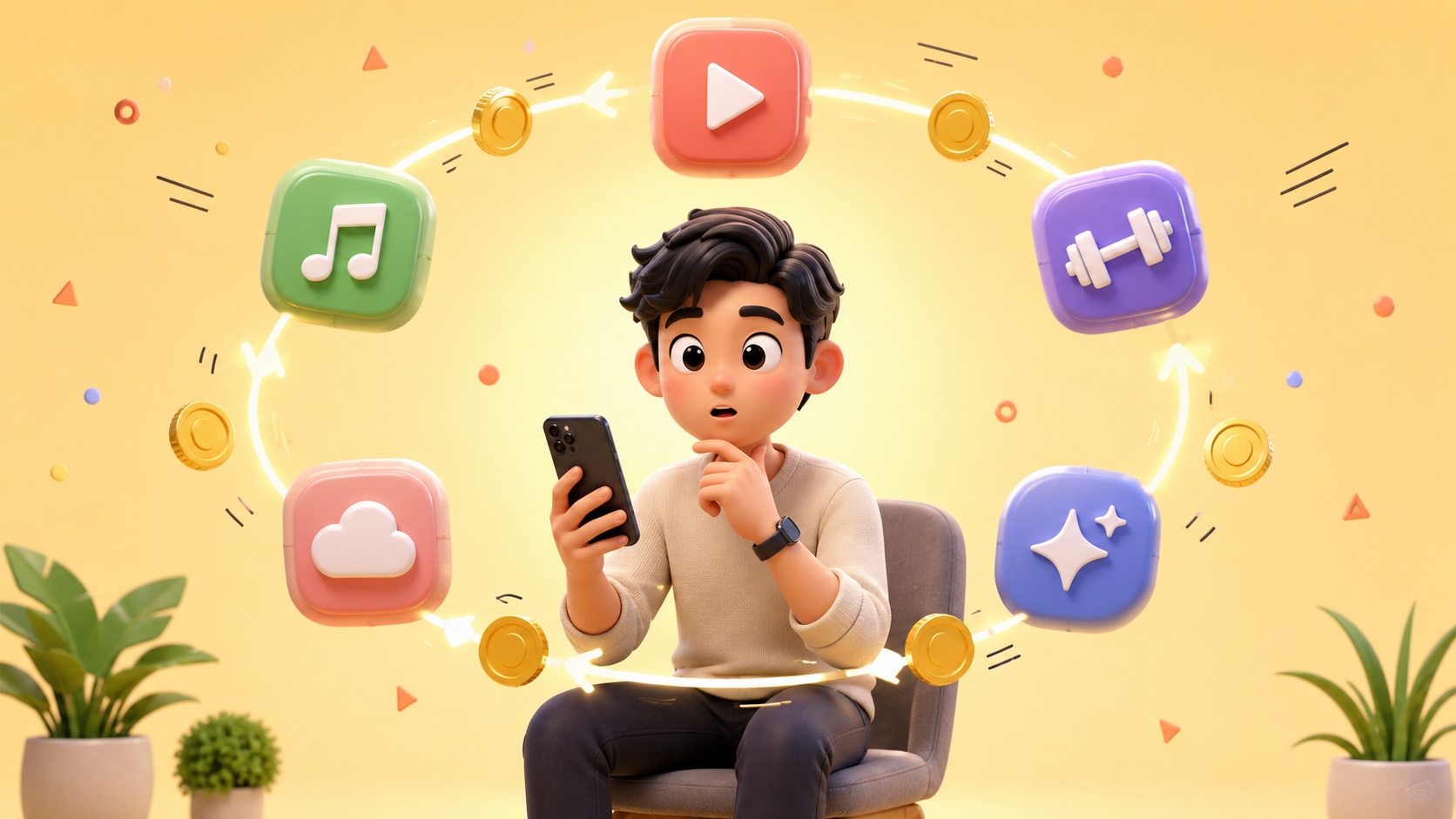
Netflix meant I could finally watch the shows everyone was talking about. Then came Google One to back up my photos, iCloud for my Apple devices, ChatGPT, Claude, and my gym membership. One by one, each subscription solved a real problem.
If you asked me whether any one of them was worth paying for, I'd probably say yes.
Then someone asked me a simple question.
"How much do you actually spend on subscriptions every month?"
I froze.
I knew ChatGPT cost around ₱1,100 after VAT. I knew my gym membership was somewhere around ₱2,000 a month. Spotify? Maybe ₱150. Netflix? Around ₱150 or ₱200, I think.
But Google One?
Was it ₱129?
₱500?
I wasn't even sure.
iCloud?
Around ₱250... I think.
What surprised me wasn't that I had forgotten these subscriptions existed.
It was that I had stopped noticing them.
For someone who spends a lot of time thinking about money, that felt strange. I built Richable. I write about personal finance. I regularly review my expenses. Yet I couldn't confidently tell you how much some of my recurring subscriptions cost.
That made me wonder if this was just my problem.
It turns out it isn't.
We Think We Spend Less Than We Actually Do
Research has consistently shown that people underestimate how much they spend on subscriptions.
One widely cited survey found that consumers believed they spent an average of US$86 a month on subscriptions. When their actual transactions were reviewed, the average came out to US$219 a month — more than twice what they thought they were paying.¹
That's a remarkable gap.
It's also surprisingly easy to understand.
Subscriptions don't ask us to make the same decision every month.
They ask us to make it only once.
The Payment Never Stops. The Decision Does.
Think about buying a new pair of shoes.
You compare different brands, check the price, maybe wait for a sale, then decide whether it's worth your money.
The decision and the payment happen together.
Subscriptions work differently.
You make the decision today.
Then your credit card quietly repeats that decision next month.
And the month after that.
And the month after that.
Without asking whether it still reflects your priorities.
Behavioral economists refer to this as consumer inertia — our tendency to stick with existing choices because changing them requires attention, effort, and another decision. Research published in the American Economic Review found that when consumers were forced to reconnect their subscriptions after replacing a payment card, cancellation rates increased significantly.²
In other words, many subscriptions don't continue because we actively choose them every month.
They continue because they quietly become the default.
That isn't carelessness.
It's simply how human decision-making works.
Every Subscription Has a Good Story
What's interesting is that this article isn't about cancelling subscriptions.
If every subscription disappeared tomorrow, I already know which ones I'd pay for again.
ChatGPT.
Claude.
My gym membership.
Probably a video streaming service too, even if it wasn't Netflix anymore.
Those subscriptions have become part of how I work, learn, create, and unwind. They make my life better.
Netflix, however, made me think.
I don't watch it nearly as much as I used to.
Yet I haven't cancelled it.
Not because I forgot.
Because every now and then I think, "The next season of Demon Slayer might be coming out."
Or maybe there's a movie everyone will suddenly start talking about.
I'm not really paying for what I'm watching today.
I'm paying for the possibility of what I might want tomorrow.
That realization surprised me.
I always assumed forgotten subscriptions stayed because people simply forgot.
Sometimes they stay because we're holding on to future possibilities.
Small Enough to Ignore
Another reason subscriptions quietly disappear into the background is that most of them don't feel expensive on their own.
Spotify doesn't.
Google One doesn't.
iCloud doesn't.
Even an AI subscription that costs over a thousand pesos a month can feel reasonable if you use it every day for work.
Every subscription has its own justification.
Music.
Cloud storage.
Productivity.
Fitness.
Entertainment.
None of them feels irresponsible in isolation.
The problem is that we rarely look at them together. If you want to see the real number, Richable's bank statement analyzer can help — upload a bank or credit card statement and it pulls your recurring charges into one categorized list, so the monthly total stops being a guess.
Instead, they get buried under everything else happening in our financial lives.
Mortgage payments.
Insurance premiums.
Dining out.
Travel.
Groceries.
Subscriptions often aren't even in our top ten monthly expenses.
Ironically, that's exactly why they become invisible.
The expenses that hurt the most naturally get our attention.
The ones that don't hurt quietly continue in the background.
The Most Dangerous Expenses Aren't Always the Biggest Ones
When we talk about financial mistakes, we usually think about large purchases.
Buying a car we couldn't afford.
Taking out too much debt.
Overspending on a vacation.
Those decisions deserve careful thought.
But some financial habits become expensive not because each payment is large, but because they quietly become permanent.
A streaming service you loved two years ago.
An app you needed for a previous project.
A free trial you intended to cancel after a month.
An AI tool that was essential before another one replaced it.
Individually, none of these decisions seems significant.
Collectively, they become part of your monthly cash flow without ever asking if they still deserve a place there.
The most expensive subscriptions aren't always the ones you forgot. They're often the ones you stopped questioning.
Your Life Changes Faster Than Your Subscriptions
One thing I've realized is that subscriptions don't automatically evolve with us.
Our careers change.
Our hobbies change.
The tools we use change.
The streaming services we watch change.
But recurring payments have a habit of staying exactly where they are.
The person who subscribed to Netflix three years ago isn't exactly the same person today.
The freelancer who needed one design tool might now use another.
The AI platform that transformed your workflow this year might not be the one you rely on next year.
Yet many subscriptions simply continue because nothing forces us to stop and ask whether we'd make the same decision again.
A Better Question to Ask
I don't think the lesson is to cancel every subscription that isn't used every single week.
Some subscriptions create tremendous value.
Mine certainly do.
The better habit is simply to pause every few months and ask one question.
If this subscription disappeared today, would I happily subscribe to it again at today's price?
If the answer is yes, keep it.
It still supports the life you're living today.
If the answer is no — or even "I'm not sure" — then perhaps you're no longer paying for the service itself.
You're paying for a decision you made months, or even years, ago.
Money has a way of becoming invisible when it moves automatically.
The goal isn't to eliminate recurring expenses.
The goal is to make sure your recurring expenses still reflect today's priorities instead of yesterday's decisions.
Because the subscriptions worth keeping aren't the ones you've been paying for the longest.
They're the ones you would choose all over again.
References
¹ C+R Research. Subscription Spending Survey. The survey found that consumers estimated they spent an average of US$86 per month on subscriptions, while their actual spending averaged US$219 per month. Available through multiple financial publications including Kiplinger and Axios.
² Einav, L., Klopack, B., & Mahoney, N. (2025). Selling Subscriptions. American Economic Review. The study found that subscription cancellation rates increased when consumers had to actively reconnect subscriptions after replacing their payment cards, highlighting the role of consumer inertia in subscription renewals.
³ Miller, K. M., & Zhang, Z. J. (2026). Should Your Subscription Business Use Auto-Renew? Harvard Business Review. The article discusses how auto-renewal and default renewal mechanisms influence consumer behavior and the growth of the subscription economy.